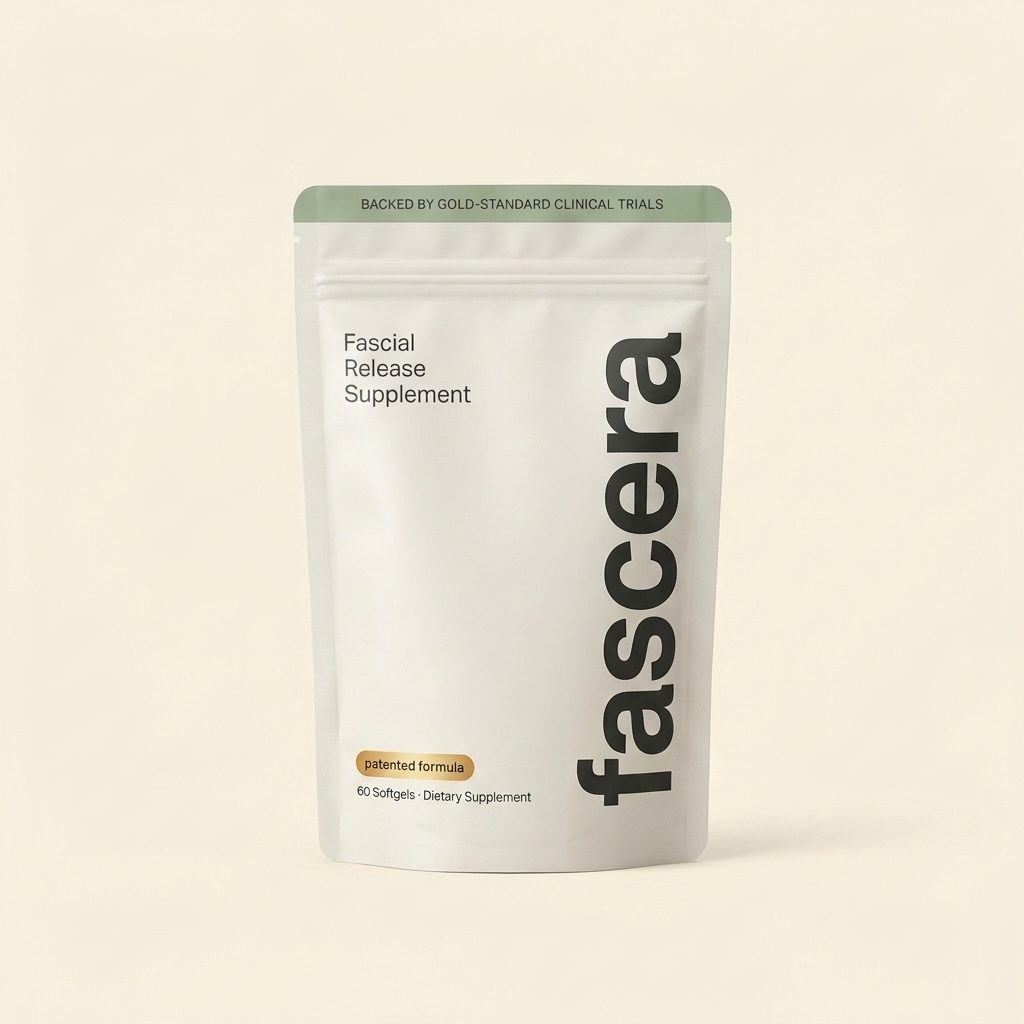
The science behind the fascial release revolution
Fascial dysfunction — fascia dehydrating, densifying and compressing the nerves inside it — is emerging in the peer-reviewed literature as an upstream driver of chronic pain and stiffness. This page walks the argument from anatomy to mechanism to the conditions it shows up in, then shows the evidence behind every ingredient in Fascera®.
Fascia is a sensory organ, not packaging
For most of modern medicine, fascia was the white film surgeons cut through to get to the important parts. The newest anatomy says otherwise.
Fascia is one continuous layer of connective tissue that wraps every muscle, joint, organ and nerve in the body. Until recently it was treated as inert — structural wrapping with no job of its own. That assumption is now gone.
Histology from the last five years shows deep fascia is densely packed with nerve endings, including the free nerve endings that register pain. In damaged or pathological fascia, the density of those pain-sensing endings goes up. Fascia doesn't just transmit pain from somewhere else. It generates it.
May 2022 Fascial Innervation: A Systematic Review of the Literature International Journal of Molecular Sciences
Systematic review of the histological literature confirming deep fascia is richly innervated by both mechanoreceptors and free nerve endings capable of signalling pain. Establishes fascia as sensory tissue rather than inert wrapping.
Aug 2024 Fascia as a regulatory system in health and disease Frontiers in Neurology
Review describing the fascial system as highly innervated, vascular and hormonally responsive — a whole-body sensing layer interdependent with the nervous system, and a plausible factor in several chronic conditions.
Jun 2025 Towards a comprehensive definition of the human fascial system Journal of Anatomy
Consensus paper from the leading fascial anatomy groups integrating histological, mechanical and clinical data into a unified definition of fascia as a single continuous, biologically active tissue.
How fascia fails: dehydrate, densify, compress
The mechanism is simple. It happens in three steps, and each step is now documented.
Healthy fascia is mostly water, held in place by hyaluronic acid produced by specialised cells inside the tissue. That water is what keeps the layers soft, translucent and able to move against each other.
When fascia loses water — through age, hormonal change, inflammation, injury or sustained stress — the hyaluronic acid clumps and the tissue densifies: it thickens, stiffens and loses the ability to move. Densified fascia then compresses the muscles and nerves running through it. That compression is the pain, the deep stiffness and the restricted movement. Densification is not fibrosis. Unlike scar tissue, it is a reversible state.
Jun 2021 Hyaluronan and the Fascial Frontier International Journal of Molecular Sciences
Examines hyaluronan as the molecule that keeps fascial layers hydrated and gliding, and how altered hyaluronan behaviour produces the thickening and loss of glide seen in densified, painful fascia.
2025 Exploring fascia in myofascial pain syndrome: an integrative model of mechanisms Frontiers in Pain Research
Integrative model linking fascial densification, fibrosis and local inflammation to sustained nociceptive input — the proposed mechanical origin of persistent myofascial pain.
May 2025 Ultrasonography of the Fasciae and Common Pathologies: The Game Changer Diagnostics
Imaging review showing fascial pathology — thickening, loss of layer separation, inflammatory change — is now directly visible on ultrasound, making it measurable rather than inferred.
2026 Thoracolumbar fascia ultrasound and elastography biomarkers in low back pain: a systematic review European Spine Journal
Systematic review of imaging studies finding measurably thicker and stiffer thoracolumbar fascia in people with chronic low back pain compared with controls.
Why it explains "unexplained" pain
Normal bloodwork. Clean imaging. Pain that doesn't match anything on the chart. Fascia is the tissue nobody was looking at.
For years, chronic pain with no visible cause was labelled central sensitisation — the nervous system turning up its own volume. That's a real phenomenon. But a nervous system doesn't amplify pain at random. It amplifies pain in response to sustained input.
Recent work shows the central changes in chronic pain patients are a normal response to abnormally persistent peripheral signal — and that when fascia-targeted procedures quiet that signal, the pain resolves. Central sensitisation is the consequence. Compressed fascia is the cause.
Mar 2023 Myofascial Pain Syndrome: A Nociceptive Condition Comorbid with Neuropathic or Nociplastic Pain Life
Argues myofascial pain is driven by ongoing peripheral nociceptive input rather than being purely a central phenomenon, and that the two mechanisms commonly coexist.
Feb 2021 Dorsal root ganglia: fibromyalgia pain factory? Clinical Rheumatology
Proposes that peripheral structures generate the sustained signal behind fibromyalgia pain, reframing central sensitisation as a consequence of persistent peripheral input rather than the primary fault.
Oct 2024 Ultrasound-guided fascial plane blocks in chronic pain: a narrative review Journal of Anesthesia, Analgesia and Critical Care
Review of chronic pain conditions that respond to anaesthetic delivered into fascial planes — evidence that quieting the signal at the fascia can resolve pain elsewhere.
May 2025 Ultrasound-Guided Hydro-Dissection of the Superficial Fascia for Cervical Myofascial Pain Journal of Clinical Ultrasound
Separating adhered fascial layers with injected fluid produced meaningful relief in cervical myofascial pain — a direct test of the mechanical hypothesis.
One tissue, many diagnoses
Chronic pain and stiffness conditions are diagnosed by different specialists, named by different symptoms and treated with different drugs. The research increasingly points at the same tissue underneath them.
Fibromyalgia, peripheral neuropathy, osteoarthritis, chronic low back and neck pain, myofascial pain, post-surgical and post-injury stiffness, hormonally driven joint pain — each gets its own label and its own clinic. What they share is a symptom picture: pain without a clear source on imaging, stiffness that is worst after rest and eases with movement, and a nervous system that seems to be amplifying everything.
That shared picture is what densified fascia produces. The studies below come from across these diagnoses. The point isn't that these are separate findings. It's that they keep finding the same thing.
Jan 2010 Fascia: A missing link in our understanding of the pathology of fibromyalgia Journal of Bodywork & Movement Therapies
The paper that first proposed fascial pathology as the overlooked substrate of fibromyalgia. Early, hypothesis-generating, and the starting point for most of the work that followed.
2022 Scoping review and interpretation of myofascial pain/fibromyalgia syndrome PLOS ONE
Scoping review proposing fascial 'armouring' — progressive regional densification spreading through a continuous tissue layer — as the mechanical bridge between localised myofascial pain and widespread fibromyalgia.
2023 Long COVID-19 and viral fibromyalgia-ness: a mechanistic role for fascial myofibroblasts Frontiers in Medicine
Suggests fascial myofibroblast activation as a shared mechanism behind post-viral widespread pain and stiffness, linking a newer diagnosis to the same tissue.
Oct 2019 Influence of female hormones on fascia elasticity: An elastography study Clinical Anatomy
Elastography study showing fascial stiffness varies directly with female hormone levels — a physical explanation for pain and stiffness that track the menstrual cycle or menopause.
Jul 2020 Fascia and soft tissues innervation in the human hip and their possible role in post-surgical pain Journal of Orthopaedic Research
Anatomical study finding the fascia and soft tissue around the hip more densely innervated than the joint capsule itself — relevant to pain that persists after the joint is addressed.
Aug 2008 Effect of pine bark extract (Pycnogenol) on symptoms of knee osteoarthritis Phytotherapy Research
Three-month randomised placebo-controlled trial reporting significant reduction in osteoarthritis symptom scores versus placebo.
Rehydrating fascia from the inside
Fascera® was built backwards from the mechanism. Every ingredient has one of four jobs. Here is the evidence for each.
A fascia formula has to do four things at once: put water back into the tissue, protect the collagen framework so the tissue can hold that water, loosen the protein build-up that keeps it compressed, and calm the inflammation that keeps it tight.
Ten ingredients do that work. The references below cover the ones with published human trials or mechanistic research behind them — not every ingredient in a formula has its own trial, and we would rather show you the gaps than pad the list.
REHYDRATE
Put water back into the tissue.
Dec 2024 Oral Hyaluronic Acid in Osteoarthritis and Low Back Pain: A Systematic Review Mediterranean Journal of Rheumatology
Systematic review of oral hyaluronic acid trials reporting reductions in pain and stiffness across studies. Evidence base is moderate in size — promising rather than settled.
Feb 2024 Oral sodium hyaluronate relieves knee discomfort: a 12-week double-blinded, placebo-controlled study Experimental and Therapeutic Medicine
Randomised placebo-controlled trial: twelve weeks of oral hyaluronic acid improved knee discomfort and stiffness against placebo.
2025 Role of oral hyaluronic acid for joint health: insights from rat models and clinical trials Frontiers in Nutrition
Translational review covering how orally taken hyaluronic acid is absorbed and distributed, drawing together animal-model and human trial evidence.
Mar 2023 Different molecular weights of hyaluronan research in knee osteoarthritis: a state-of-the-art review Matrix Biology
Review of how molecular weight changes hyaluronan's behaviour in tissue — the basis for using the high-molecular-weight form rather than a generic one.
PROTECT THE FRAMEWORK
Fascia that is losing its collagen scaffold can't hold water.
2026 Boron as a context-dependent system-level modulator: mechanisms and implications Biological Trace Element Research
Review of boron's role in connective tissue, mineral retention and inflammatory balance. Mechanistic rather than a clinical outcome trial.
LOOSEN DENSIFIED TISSUE
Break up the protein build-up that keeps fascia compressed.
Oct 2022 Serratiopeptidase: an integrated view of a multifaceted therapeutic enzyme Biomolecules
Review of serrapeptase's anti-inflammatory, fibrinolytic and anti-fibrotic mechanisms, and how it is absorbed and acts systemically.
Mar 2021 Efficacy of serratiopeptidase after impacted third molar surgery: a randomized controlled trial BMC Oral Health
Randomised controlled trial showing significant reduction in soft-tissue swelling and restricted movement versus control. Surgical model, not a fascia model — included as direct evidence the enzyme acts on soft tissue.
Mar 2024 An up-to-date review of biomedical applications of serratiopeptidase Archives of Microbiology
Current review of the clinical evidence base and known limitations, including absorption and enteric-coating considerations.
CALM THE INFLAMMATION KEEPING IT TIGHT
Low-grade inflammation is what keeps fascia reactive.
Dec 2024 Efficacy of extracts of oleogum resin of Boswellia in the treatment of knee osteoarthritis Phytotherapy Research
Systematic review and meta-analysis of standardised Boswellia extracts reporting significant pain and stiffness reduction across randomised trials.
Sep 2024 Efficacy evaluation of standardized Boswellia serrata extract (Aflapin) in osteoarthritis Explore
Clinical evaluation of a standardised boswellic acid extract, reporting symptom improvement within days rather than weeks.
Sep 2024 Topical application of Centella asiatica in wound healing: recent insights into mechanisms Pharmaceutics
Mechanistic review of how Centella's triterpenes stimulate collagen synthesis and moderate inflammation in connective tissue. Note: this evidence is topical and preclinical, not oral human trials.
Apr 2024 Comparison of the antioxidant potency of four triterpenes of Centella asiatica Antioxidants
Compares the activity of Centella's individual active compounds — the basis for standardising an extract rather than using raw herb.
Why you're only hearing about this now
The research is real. It's also recent — and no one is paid to tell you about it.
Nearly every study on this page is from the last five years. The nerve network inside fascia was mapped in 2021. The first reliable imaging of fascial pathology arrived in 2025. Medical training runs ten to fifteen years behind frontline research, so most physicians haven't been taught any of it yet.
The second reason is structural. The compounds fascia needs to rehydrate are natural and can't be patented. Without patent protection there is no pharmaceutical budget for the large trials and physician education that move a treatment into the exam room. The science exists. The marketing machine doesn't. That gap is the reason this page exists.
2025 Comparative effectiveness of nutritional supplements in the treatment of knee osteoarthritis Nutrients
Network comparison of supplement categories in osteoarthritis. Useful as a reality check on effect sizes across the whole category, including the ingredients used here.
Sep 2020 Pine bark (Pinus spp.) extract for treating chronic disorders Cochrane Database of Systematic Reviews
Cochrane review concluding the evidence for pine bark extract across chronic conditions remains limited and of low certainty — included because an honest evidence page shows the cautious reviews too.
All studies cited are independently published, peer-reviewed and publicly verifiable. Fascera Labs did not fund, design or conduct any of the research on this page. The presence of a study here is not a treatment claim — Fascera® is a dietary supplement and is not intended to diagnose, treat, cure or prevent any disease.
Try it for a full 90 days.
The tissue moves slowly. So does the guarantee.
90-Day Money-Back Guarantee · Made in the USA · Third-Party Tested